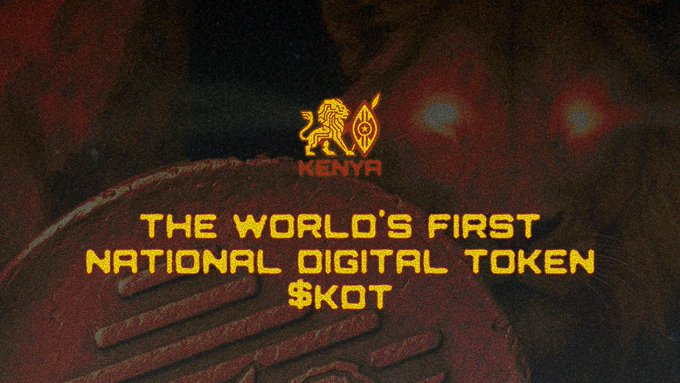
The Kenya Digital Token (KDT) is facing renewed scrutiny over its wallet distribution, available liquidity and the public attention it received after Cabinet Secretary William Kabogo discussed the privately developed project in 2025. The token operates on the Solana blockchain and was presented at launch as a civic and community-oriented digital initiative connected to Kenya’s growing interest in blockchain technology.
KDT was launched in July 2025 by private developers rather than as an official Kenyan government currency. Public statements surrounding its launch described the project as supporting themes including national identity, youth participation, financial inclusion and digital innovation. Kabogo, who serves as Cabinet Secretary for Information, Communications and the Digital Economy, publicly welcomed the initiative and described it as a private-sector project aligned with broader digital transformation goals.
That public association has since become an important part of the discussion surrounding KDT. A statement attributed to the Ministry of Information, Communications and the Digital Economy made clear that the token was independently developed and distributed by private innovators. Consequently, the existence of a public endorsement should not be interpreted as evidence that KDT was issued, owned or guaranteed by the Kenyan government.
At the same time, third-party blockchain analytics platforms have raised questions about the token’s liquidity and distribution among wallets. Those indicators are worth examining, but they do not by themselves establish fraud, market manipulation or a planned collapse. Wallet concentration can result from several legitimate arrangements, including treasury holdings, allocations to early participants or liquidity-management structures.
What is the Kenya Digital Token?
The Kenya Digital Token is a cryptocurrency project operating on the Solana blockchain. Reports published around its launch described KDT as a privately developed initiative designed around Kenya’s digital economy and civic identity.
The project emerged during a period when Kenya was increasingly discussing blockchain technology, digital assets and broader financial technology innovation.
Its branding and messaging connected the token with themes that are already prominent in Kenya’s digital transformation agenda. However, that association does not make KDT an official sovereign currency or a government-issued digital currency.
This distinction is particularly important because a token can use national imagery, terminology or themes without being created or guaranteed by the state.
Why William Kabogo’s comments attracted attention
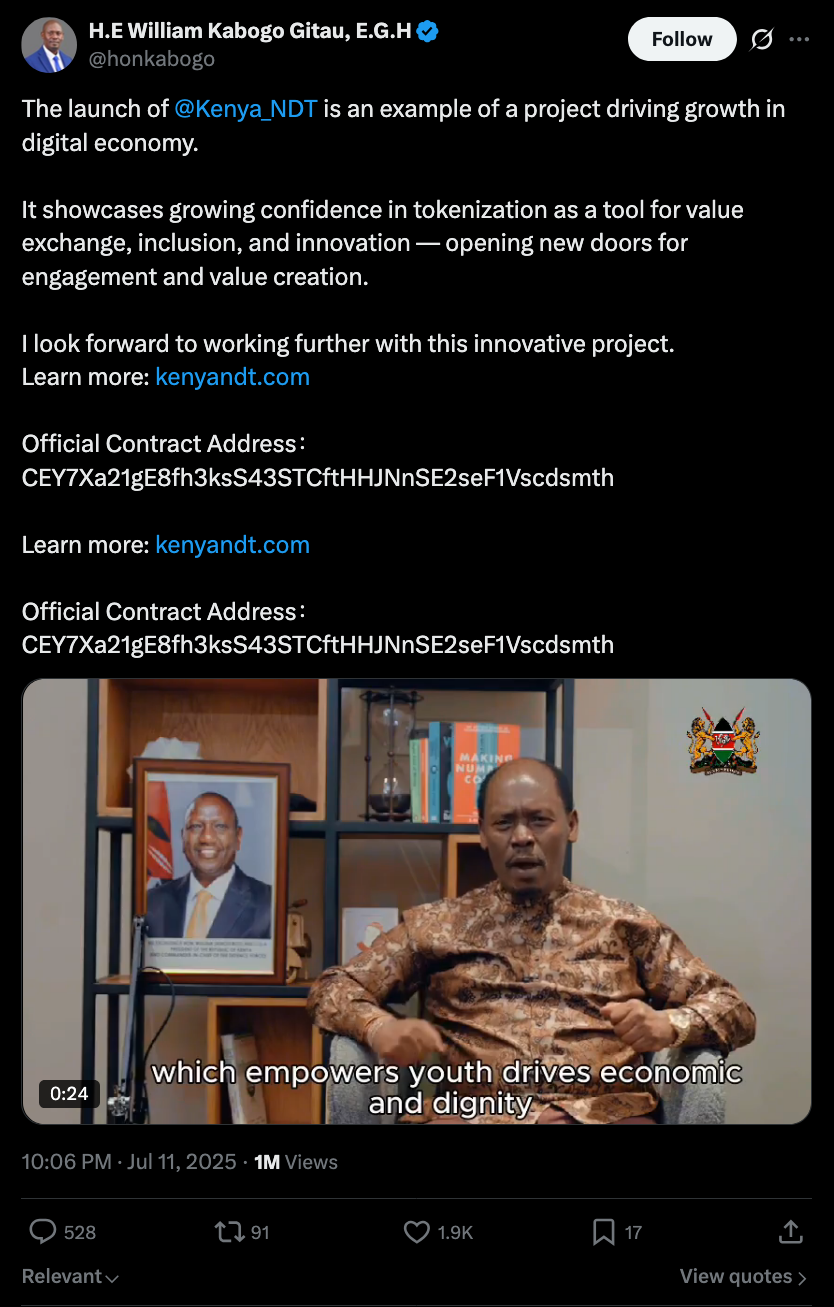
William Kabogo publicly discussed the Kenya Digital Token shortly after its launch.
According to material released in connection with the project, Kabogo described KDT as a private-sector civic initiative and linked it to wider discussions about digital innovation and Kenya’s technological development.
Because Kabogo is a senior government official responsible for the digital economy portfolio, his public comments gave the project considerable visibility.
However, the available launch material also stated that the token was developed and distributed independently by private innovators. That distinction means the public discussion around KDT needs to separate the official’s comments from the legal status and ownership of the token itself.
There is also no evidence in the sources reviewed for this article establishing that Kabogo owns or controls the wallets that have attracted scrutiny.
Wallet concentration is one area under scrutiny
Blockchain transactions are publicly observable, allowing researchers and analytics companies to examine how tokens are distributed across addresses.
Third-party analysis cited in reports about KDT has raised concerns about the concentration of tokens among groups of connected wallets.
Wallet clustering, however, needs to be interpreted carefully. Several addresses can be controlled by one organization, or separate wallets can be used for treasury management, market making, early allocations or other legitimate purposes.
Therefore, a high concentration of tokens does not automatically prove that the holders intend to sell, manipulate the market or cause losses to other participants.
The more relevant question is whether the ownership structure is clearly disclosed and whether holders understand how much of the supply is controlled by connected entities.
Liquidity presents a separate question
Liquidity is another important factor when assessing a cryptocurrency market.
A token can have a quoted price while still having relatively limited liquidity. In such circumstances, a relatively small transaction can potentially produce a significant price movement because there may not be enough opposing orders or pooled liquidity to absorb the trade.
Third-party risk assessments have flagged limited liquidity for KDT. These assessments should be viewed as indicators rather than definitive findings about the project’s intentions.
Liquidity can also change over time. A snapshot from one point in the token’s history does not necessarily describe its current market conditions.
For that reason, reports about KDT’s liquidity should always identify when the underlying data was collected.
Solana provides the technical infrastructure
KDT operates on Solana, a blockchain network used by a large number of cryptocurrency and decentralized-finance projects.
Using Solana does not establish whether a particular token is legitimate or unsafe. The blockchain provides the underlying infrastructure, while individual projects determine their own token distribution, governance arrangements, liquidity structures and development plans.
The distinction matters because problems associated with one Solana token should not automatically be attributed to the entire blockchain.
Likewise, the fact that other projects on a blockchain have experienced failures does not establish that KDT will experience the same outcome.
Risk scanners can identify warning indicators
Blockchain analytics platforms such as De.Fi and Solflare provide automated or semi-automated assessments of cryptocurrency tokens.
These tools can examine factors such as wallet concentration, liquidity, token verification and certain contract characteristics.
Such assessments can be useful starting points for investigation, but they should not be treated as regulatory determinations or definitive proof that a token is fraudulent.
A risk score is also not equivalent to a finding by a financial regulator.
The appropriate interpretation is that a scanner has identified characteristics that may deserve additional scrutiny.
Token supply figures can complicate valuation
Another issue that can affect cryptocurrency analysis is the difference between total supply, circulating supply and tokens held in wallets that may be subject to restrictions.
A project can have a large total supply while only a smaller amount is actively circulating.
Conversely, different cryptocurrency data providers may calculate circulating supply differently, particularly when information about locked allocations, treasury wallets or distribution schedules is incomplete.
This can make comparisons between reported market capitalization figures difficult.
For KDT, any assessment of valuation should therefore identify the data source, the date of the calculation and the definition of circulating supply being used.
Kenya’s virtual-asset regulations are developing
KDT’s scrutiny comes as Kenya establishes a formal legal framework for virtual assets.
The Virtual Assets Service Providers Act, 2025, established a framework for regulating and supervising virtual asset service providers, with CBK and the Capital Markets Authority designated as regulators for the services covered by the law. A government notice issued when the Act commenced stated that no VASPs had yet been licensed under the Act and that licensing would commence after the necessary regulations were issued.
The regulatory process has subsequently moved forward.
The National Treasury, in consultation with CBK and CMA, published draft Virtual Asset Service Providers Regulations in 2026 to operationalize the legal framework. The regulations address licensing and other requirements for businesses operating within the regulated virtual-asset sector.
This evolving framework is significant for the wider cryptocurrency market because regulatory status can differ between a token project itself and a company providing regulated virtual-asset services.
KDT should not be confused with a government digital currency
One of the most important distinctions for readers is between a privately developed token and an official central bank digital currency.
The available launch material identifies KDT as a private-sector initiative. It was not presented in the cited material as a Kenyan government-issued currency.
A government official discussing or welcoming a private blockchain project does not, by itself, turn that project into a state-backed financial instrument.
This distinction becomes particularly important when national symbols, government policy language or the names of public officials appear in marketing surrounding a digital asset.
What the available evidence does and does not establish
The available information establishes that KDT was launched as a private digital-token project on Solana and that William Kabogo publicly discussed the initiative around its launch.
Third-party analytics have also raised questions about aspects of its token distribution and liquidity.
However, those findings do not by themselves establish that KDT is a scam, that a particular individual controls the wallets in question, or that a future loss is inevitable.
Likewise, the presence of government-related messaging around the launch should not be interpreted as a government guarantee of the token’s value.
These distinctions are important because cryptocurrency markets can change quickly, while blockchain data can be difficult to interpret without information about the people and entities behind particular addresses.
Why transparency matters for digital-token projects
For a cryptocurrency project to build confidence, information about token supply, allocation, locked holdings, liquidity arrangements, development plans and governance can be important.
Clear disclosure can help users distinguish between treasury wallets, investor allocations, liquidity pools and wallets controlled by project insiders.
It can also make independent analysis easier.
As Kenya develops its virtual-asset regulatory framework, transparency, consumer protection and responsible market conduct are likely to remain important issues for businesses and users participating in the sector.
Kenya’s cryptocurrency market enters a more regulated phase
The discussion around the Kenya Digital Token comes at a significant point for Kenya’s digital-asset industry.
The country is moving from a period in which cryptocurrency businesses operated within a less developed dedicated regulatory framework toward a system that includes legislation and regulations specifically addressing virtual assets.
For KDT, the key issues are therefore not limited to its branding or its association with public statements. Its token distribution, liquidity, disclosures, ownership structures and relationship with regulated entities are also relevant when assessing the project.
At present, the evidence reviewed does not establish that KDT is a proven fraudulent scheme. It does, however, show why questions about wallet concentration, liquidity and the distinction between private projects and government initiatives deserve careful examination as Kenya’s digital-asset sector develops.