
Trump Bans Anthropic in what may become one of the most consequential moments for the American artificial intelligence industry. The administration has effectively barred one of the country’s leading AI firms from conducting business with the federal government, while simultaneously backing its rival, OpenAI, for expanded defense deployment.
At the center of the dispute is Anthropic, the developer behind Claude AI. Reports indicate that the Department of Defense, now renamed the Department of War under the current administration, sought unrestricted access to Anthropic’s technology. According to multiple accounts, CEO Dario Amodei declined that request.
The company reportedly asked for written guarantees that its AI systems would not be used for mass domestic surveillance or deployed in autonomous weapons capable of making life-or-death decisions without human authorization. While such conditions may appear aligned with common AI safety principles, administration officials viewed the refusal as defiance.
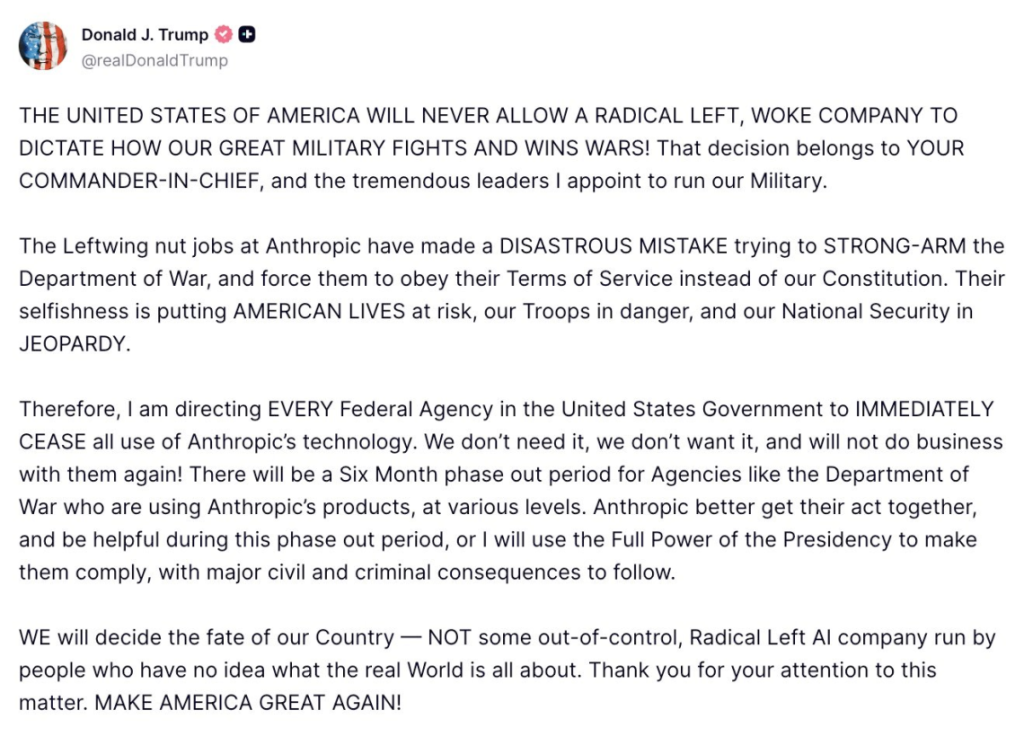
President Donald Trump publicly criticized Anthropic, labeling the firm “radical left” and “woke.” He suggested that its stance could undermine national security and the safety of American troops.
Federal Ban and “Supply Chain Risk” Designation
Shortly after the public remarks, the White House issued directives instructing all federal agencies to immediately cease using Anthropic’s products. Defense Secretary Pete Hegseth escalated the situation further by formally designating Anthropic as a “supply chain risk to national security.”
This classification is typically reserved for foreign adversaries or overseas companies suspected of espionage or sabotage. It has not previously been applied to a domestic American technology firm.
As a result of the decision, all federal agencies are now barred from purchasing or utilizing Anthropic’s services. The restriction extends beyond government departments. Any private company holding a federal contract is also effectively prohibited from integrating Anthropic’s technology into its operations.
The Trump Bans Anthropic move therefore impacts not only public-sector AI usage but also large segments of the defense contracting ecosystem.
OpenAI Emerges as the Beneficiary
Within hours of the announcement, OpenAI emerged as the primary beneficiary. CEO Sam Altman revealed that the company had reached an agreement with the Department of War to deploy its AI models across classified Pentagon networks.
According to Altman, OpenAI personnel would work directly inside military facilities. He stated that the agreement includes commitments to safety principles such as bans on domestic mass surveillance and maintaining human oversight in decisions involving the use of force.
Altman also noted that OpenAI would implement technical safeguards and limit deployments to controlled cloud environments. However, questions remain about oversight mechanisms and enforcement responsibility.
The Trump Bans Anthropic decision has therefore reshaped the competitive landscape of federal AI contracts almost overnight.
Congressional Silence and Broader Implications
One of the most striking aspects of the controversy is the limited involvement of the U.S. Congress. Lawmakers have so far played no substantial role in shaping or reviewing these new federal AI arrangements.
Critics argue that decisions involving advanced AI deployment in military systems warrant legislative oversight. Supporters of the administration counter that national security demands swift executive action.
The broader implications for the AI industry are significant. The Trump Bans Anthropic order signals that federal access to lucrative government contracts may hinge not only on technical capability, but also on alignment with executive priorities.
Meanwhile, unresolved questions remain. What specific applications does the government intend to pursue with expanded AI access? How will ethical safeguards be monitored? And will this decision set a precedent for how future administrations handle AI firms that challenge defense-related directives?
As the situation develops, the Trump Bans Anthropic episode may become a defining case study in the intersection of artificial intelligence, national security, and executive power in the United States.