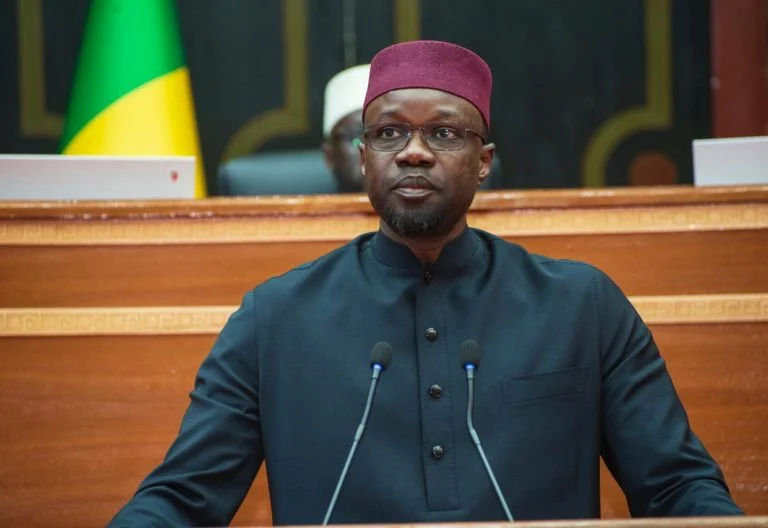
Senegal’s political crisis escalated sharply on Tuesday after former Prime Minister Ousmane Sonko returned to parliament and secured election as president of the National Assembly just days after being dismissed from government by President Bassirou Diomaye Faye.
The dramatic political reversal has exposed widening divisions at the heart of Senegal’s ruling Pastef movement, the same coalition that swept to power in 2024 promising institutional reform and political renewal.
Sonko Returns to Parliament After Dismissal
Earlier on Tuesday, lawmakers voted to reinstate Sonko as a deputy in Senegal’s National Assembly following his removal from the premiership.
Hours later, parliament elected him president of the assembly with overwhelming backing from Pastef lawmakers, who currently dominate the chamber with 130 seats out of 165.
The vote effectively places Sonko at the head of one of Senegal’s most powerful institutions despite his recent dismissal from the executive branch.
Political observers say the move significantly strengthens Sonko’s influence and creates an unusual power arrangement between the presidency and parliament.
Rift Between Faye and Sonko Now Public
The latest developments underline what analysts increasingly describe as a growing rupture between President Faye and Sonko, longtime political allies who campaigned together during Senegal’s turbulent 2024 elections.
Sonko was widely viewed as the driving force behind the Pastef movement before legal challenges prevented him from contesting the presidency directly. Faye eventually became the coalition’s candidate and won the election with Sonko’s support.
For much of the past two years, the pair publicly projected unity.
However, tensions have reportedly intensified behind the scenes over governance, political appointments, economic management, and the balance of power within the ruling coalition.
Tuesday’s parliamentary showdown appears to have transformed those tensions into an open institutional confrontation.
Constitutional Court Battle Adds to Tensions
Reports from Dakar indicate President Faye attempted to prevent Sonko’s parliamentary return through intervention by the Constitutional Court.
Despite those efforts, lawmakers proceeded with both Sonko’s reinstatement and his subsequent election as speaker.
The failed attempt to block the vote could weaken perceptions of presidential authority while simultaneously reinforcing Sonko’s standing among Pastef supporters.
The situation also raises concerns about possible institutional deadlock if tensions between the executive and legislative branches continue escalating.
Why the Senegal Political Crisis Matters
Senegal has long been regarded as one of West Africa’s most stable democracies, especially compared with neighboring countries that have experienced coups, military takeovers, or prolonged political unrest.
The growing rivalry between Faye and Sonko therefore carries broader regional significance.
Analysts warn that prolonged instability within the ruling coalition could:
- Slow economic reforms
- Disrupt governance
- Increase investor uncertainty
- Trigger political protests
- Divide the Pastef movement internally
The crisis also comes at a sensitive time for Senegal’s economy as the country seeks to manage energy projects, youth unemployment pressures, and broader regional security concerns.
What Happens Next
Sonko’s election as National Assembly president gives him a major political platform and institutional leverage even outside government.
As speaker, he now occupies one of the highest-ranking offices in Senegal’s political system and retains significant influence over legislative priorities and parliamentary debate.
The key question now is whether President Faye and Sonko can repair their alliance or whether Senegal is entering a prolonged internal power struggle within the ruling establishment.
For now, the events of May 26 mark one of the most significant political turning points in Senegal since Pastef came to power in 2024.