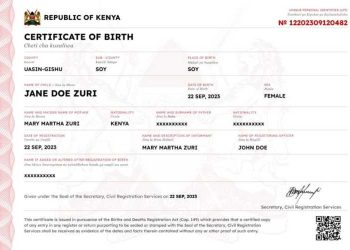

Kenya data marketplace plans are moving closer to reality as the government considers a new framework that would allow public institutions to sell selected datasets collected through digital platforms such as eCitizen.
The Ministry of Information, Communications and the Digital Economy has proposed the creation of a National Data Governance and Emerging Technologies Council, a body that would coordinate how government data is collected, packaged, priced and distributed to approved users.
Under the proposal, the government wants to make at least 1,000 datasets available over five years through a state-run digital marketplace. The platform is expected to cost up to Sh396 million to develop and operate, with the broader aim of turning government-held information into a commercial asset.
The datasets would cover information already generated by public institutions, including business registration patterns, passport application volumes, vehicle registration statistics, land transaction trends, agricultural production data and traffic movement patterns.
The government says the data would be aggregated and anonymised. That means it should not identify individual citizens. Names, phone numbers, national identity numbers, email addresses, images and other personal identifiers would not be included, in line with Kenya’s existing data protection laws.
Why Kenya Wants a Data Marketplace
The proposal reflects a wider shift in how governments view public data. For years, state agencies have collected large volumes of information for administrative purposes. That data has helped process applications, issue licences, manage public services and monitor economic activity.
The Kenya data marketplace plan treats that information differently. Instead of viewing it only as an internal government resource, the policy frames data as a national strategic asset with economic value.
For businesses, aggregated public data can support market research, investment planning, logistics, credit analysis, real estate decisions and agricultural forecasting. For researchers and universities, it can help track social and economic trends. For NGOs and development agencies, it can improve targeting of public programmes.
A dataset showing regional business registrations, for example, could help investors understand where entrepreneurship is growing. Vehicle registration data could show transport demand. Crop production figures could guide food security planning. Land transaction trends could help analysts track property activity.
None of that information needs to expose a private citizen’s identity to be commercially useful.
The U.S. DMV Precedent
Kenya is not the first government to consider public data as a source of revenue. A long-running example exists in the United States, where state Departments of Motor Vehicles have generated large sums by selling driver information.
The American model is more controversial because it involves personal data. Under federal rules, state motor vehicle agencies can share certain driver information with approved users such as insurers, private investigators, towing companies, vehicle dealers, universities and data brokers.
An InvestigateTV review found that 23 U.S. states collected at least $282 million in one fiscal year from selling driver data. Georgia led with more than $53 million, followed by California with $49 million, Indiana with $25 million and Ohio with $20 million from 289 companies.
The comparison with Kenya is not exact. Kenya’s proposal says personal data will not be sold. The U.S. DMV system involves more sensitive information, including names, addresses and driver-related records.
Even so, the American example shows why governments are increasingly interested in monetising the data they already hold. When packaged and sold at scale, public information can become a meaningful revenue stream.
Why the Kenya Model Is Different
The Kenya data marketplace would be closer to a paid version of an open data portal than to the U.S. DMV model. Instead of selling personal records, the government says it would sell aggregated datasets that show broad trends.
Some datasets may remain free for public interest use, while others could be priced under tiers that have not yet been fully defined.
That pricing question is important. If the government charges too much, researchers, startups, journalists and small businesses may be locked out. If the data is priced too cheaply, the marketplace may fail to recover its operating costs or generate meaningful revenue.
The real test will be whether Kenya can create a marketplace that serves both public interest and commercial demand.
Privacy Concerns Remain
The proposal draws a clear line around personal data, but privacy concerns remain.
Anonymised data is not always risk-free. In some cases, datasets can be combined with other information to identify individuals or small groups, especially where the data is detailed, location-specific or linked to rare events.
That is known as re-identification risk. It is one of the biggest legal and technical challenges in any government data marketplace.
Kenya will need strict rules on how datasets are prepared, reviewed and released. The government will also need clear limits on who can buy sensitive datasets, how the data can be used, whether it can be resold, and what penalties apply when buyers misuse it.
Without strong oversight, the marketplace could create public distrust, especially because much of the underlying data comes from citizens using government services.
The Revenue Question
The government’s revenue expectations will depend on demand.
Large firms, banks, insurers, telecoms, logistics companies, universities, consulting firms and development organisations may be willing to pay for high-quality national datasets. But buyers will only pay if the information is accurate, current, easy to access and legally safe to use.
Kenya also has to prove that the marketplace will not become another expensive digital project with limited uptake. The proposed Sh396 million cost means the platform must attract enough buyers or deliver enough public value to justify the investment.
The most valuable datasets are likely to be those that help users make decisions. Business registrations, land transactions, traffic patterns, agricultural output and public service usage could all attract interest if updated regularly and presented in usable formats.
What the Government Still Needs to Clarify
Several major questions remain unanswered.
The government has not yet clearly stated which datasets will be free and which will be sold. It has not explained the pricing model. It has not fully outlined safeguards against re-identification. It has also not made clear how the proposed council would coordinate with the Office of the Data Protection Commissioner.
Public trust will depend on transparency. Kenyans will need to know what data is being sold, who is buying it, how much money is being collected and how privacy will be protected.
A public register of available datasets, buyers, pricing categories and approved use cases would make the system more credible.
Kenya’s Data Economy Moment
Kenya’s digital government systems have grown rapidly, and platforms such as eCitizen now generate large volumes of administrative information. That creates an opportunity, but also a responsibility.
Used properly, a Kenya data marketplace could support research, investment, planning and innovation. It could help the government raise revenue without increasing taxes. It could also make public information more useful to the private sector and development partners.
Handled poorly, however, it could raise privacy fears, exclude smaller users through high pricing, or create a market where public data benefits only a narrow group of well-funded buyers.
Kenya’s challenge is to build a system that treats public data as valuable without forgetting that it was generated through public trust.