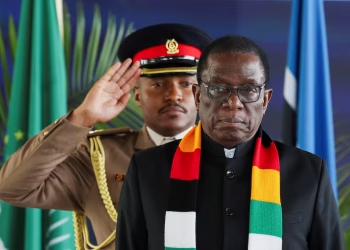

How Jesse Jackson reshaped the civil rights movement and paved the way for modern Black presidential politics in America.
Jesse Jackson remains one of the most influential figures in modern American political history. As a leading voice in the civil rights movement, Jesse Jackson transformed grassroots activism into national electoral power. His journey from protest marches in the segregated South to major-party presidential campaigns reshaped the political landscape and expanded opportunities for Black Americans seeking national office.
During the 1960s, Jesse Jackson emerged as a prominent advocate for racial equality under the mentorship of Martin Luther King Jr. At a time when African Americans faced legal segregation and economic exclusion, Jackson helped organize communities and demand systemic change. However, his ambitions went beyond protest. Unlike many activists of his generation, he believed political participation could drive structural reform. That conviction defined his career.
Jesse Jackson became the first African American candidate to achieve substantial success in a major Democratic presidential primary. His campaigns demonstrated that a Black candidate could mobilize millions of voters across racial and geographic lines. Moreover, his message of a “rainbow coalition” introduced a multiracial political framework that influenced future leaders, including Barack Obama and Kamala Harris.
Early Life and Roots in the Civil Rights Movement
Jesse Jackson was born on 8 October 1941 in Greenville, South Carolina. Raised in a segregated society, he experienced firsthand the limits imposed on Black Americans. Churches played a central role in his upbringing, as they did in many Black communities during segregation. Faith institutions often served as organizing hubs for political resistance.
As a student at North Carolina A&T, Jackson became active in the civil rights movement. In 1960, he participated in a peaceful protest at a whites-only library. That action contributed to the desegregation of the facility. His involvement deepened over time, eventually bringing him into the orbit of Martin Luther King Jr.
Through the Southern Christian Leadership Conference, Jackson helped advance economic justice initiatives. He later led Operation Breadbasket in Chicago, encouraging Black consumers to support businesses that practiced fair hiring. This strategy blended economic leverage with civil rights activism.
From Activism to Political Leadership
The assassination of Martin Luther King Jr in 1968 marked a turning point. Jesse Jackson quickly assumed a more visible leadership role. He argued that inequality stemmed not only from racism but also from class divisions. By linking race and economic justice, he broadened the civil rights agenda.
In the early 1970s, Jackson founded Operation PUSH, later merging it into Rainbow/PUSH. The organization promoted education, affirmative action, and economic opportunity. Through media appearances and national campaigns, he built a broad following.
At the same time, Jesse Jackson remained a controversial figure. Critics challenged some of his past remarks and political positions. Nonetheless, his influence continued to grow.
Presidential Campaigns and the Rainbow Coalition
Jesse Jackson launched his first presidential campaign in 1984. His platform centered on economic justice, universal healthcare, and expanded social programs. He introduced the concept of the “rainbow coalition,” which sought to unite working-class Americans of diverse backgrounds.
Although he did not secure the Democratic nomination, his campaign drew more than three million votes. That performance proved historic. For the first time, a Black candidate demonstrated nationwide electoral viability within a major party.
In 1988, Jesse Jackson ran again. This time, he won nearly seven million votes and secured over 1,000 delegates at the Democratic National Convention. His speech at the convention, which ended with the phrase “keep hope alive,” resonated across generations.
Importantly, Jackson’s campaigns pressured the Democratic Party to reform its primary system. These reforms made it easier for outsider candidates to compete. Many analysts later credited those changes with helping pave the way for Barack Obama’s successful 2008 campaign.
International Diplomacy and Public Engagement
Beyond electoral politics, Jesse Jackson engaged in high-profile diplomatic missions. In 1983, he traveled to Syria and secured the release of a captured American pilot. Years later, he visited Iraq in an effort to free Western hostages.
These missions elevated his international profile. They also reinforced his image as a moral advocate rather than a conventional politician. However, critics sometimes viewed these efforts as media-driven.
Later Years and Personal Challenges
As Jesse Jackson aged, his role shifted toward that of elder statesman within the Democratic Party. He supported Barack Obama’s candidacy, though their relationship experienced tension at times. When Obama won the presidency, many observers noted that Jackson’s groundwork had expanded Black political participation.
Nevertheless, Jackson’s later years included personal and family challenges. His son, Jesse Jackson Jr, faced legal troubles related to campaign finance violations. Additionally, Jackson himself was diagnosed with a degenerative neurological condition, leading him to withdraw from daily leadership of Rainbow/PUSH.
Even so, Jesse Jackson continued to speak out on issues such as voting rights, economic inequality, and foreign policy. He appeared at national political conventions, where leaders publicly acknowledged his contributions.
Enduring Political Impact
The legacy of Jesse Jackson extends beyond individual campaigns. His insistence on multiracial coalition-building reshaped Democratic Party strategy. He broadened conversations about poverty, healthcare, and systemic inequality.
Moreover, Jesse Jackson demonstrated that political activism and electoral politics could intersect effectively. His campaigns did not merely seek office. They mobilized communities, registered voters, and influenced policy debates.
Today, discussions about inclusive democracy often trace back to frameworks Jackson popularized decades earlier. His role in the civil rights movement and presidential politics altered the trajectory of American political history.
Adapted from BBC News