
The wireless industry is making waves again with the unveiling of Wi-Fi 8 routers and chips at CES 2026, even though the IEEE 802.11bn specification won’t be finalized until 2028. This early push means consumers could soon be buying Wi-Fi 8 hardware based on a draft standard, which still has room for change.
This marks one of the shortest gaps between Wi-Fi generations, especially considering Wi-Fi 7 only launched commercially in 2024.
What’s New with Wi-Fi 8?
Unlike its predecessors, Wi-Fi 8 is not focused on increasing maximum data rates. Instead, it aims to address issues that users face in everyday usage, such as inconsistent performance, dropped connections, and lag. Wi-Fi 8’s primary focus is on stability, power efficiency, and handling multiple devices competing for bandwidth. It aims to improve performance in environments with interference or when multiple users are streaming, gaming, or on video calls simultaneously.
Wi-Fi 8’s goal is to reduce packet loss and latency, particularly for time-sensitive applications, without inflating speed numbers for marketing purposes.
Hardware Concepts and New Chips
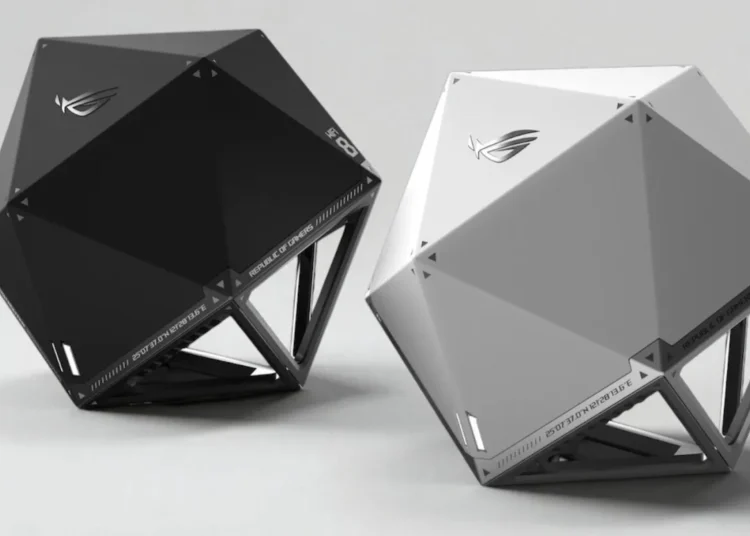
At CES 2026, several companies revealed their Wi-Fi 8 hardware concepts. Asus introduced the ROG NeoCore, a router designed to resemble a 20-sided die and avoid the usual antenna clutter. However, during the demonstration, the prototype broke, which wasn’t ideal for showcasing its build quality.
Broadcom also presented its BCM4918 application processor, along with two dual-band radios, the BCM6714 and BCM6719. These chips combine 2.4 GHz and 5 GHz operations on a single piece of silicon, reducing the need for external components. The chips are designed for consumer routers and service provider gateways.
Meanwhile, MediaTek launched its Filogic 8000 series, targeting everything from enterprise access points to smartphones, laptops, smart TVs, and smart home devices. Both Broadcom and MediaTek expect products with their chips to ship later this year.
Broadcom’s Push for AI Capabilities
Broadcom is positioning its BCM4918 chip as more than just a networking component. The chip includes a neural engine for on-device machine learning and handles networking traffic without involving the CPU. It also supports hardware acceleration for cryptographic protocols, enabling real-time responsiveness for edge AI applications.
While it’s not clear whether this will have a significant impact on typical home use, Broadcom seems to be betting on edge AI applications becoming more common and relying on real-time network performance.
Wi-Fi 8 Certification and Risks
The Wi-Fi Alliance is still deciding which features will make it into the final Wi-Fi 8 certification. Kevin Robinson, the organization’s CEO, confirmed that manufacturers often begin building products before standards are finalized. While this approach generally works out, it does introduce risks.
Anyone buying Wi-Fi 8 hardware in 2026 will be purchasing based on a draft specification. When the IEEE 802.11bn standard is finalized in 2028, devices may require firmware updates to match the final version of the specification. In the best case, this will be a simple software update. In the worst case, some advertised features might not work as expected, or hardware changes may be needed—something early buyers may not receive.
This pattern has played out with previous Wi-Fi generations, but it’s important to be aware of the uncertainty. If you’re not keen on being an early adopter, waiting for fully certified Wi-Fi 8 hardware after 2028 might be the safer route.