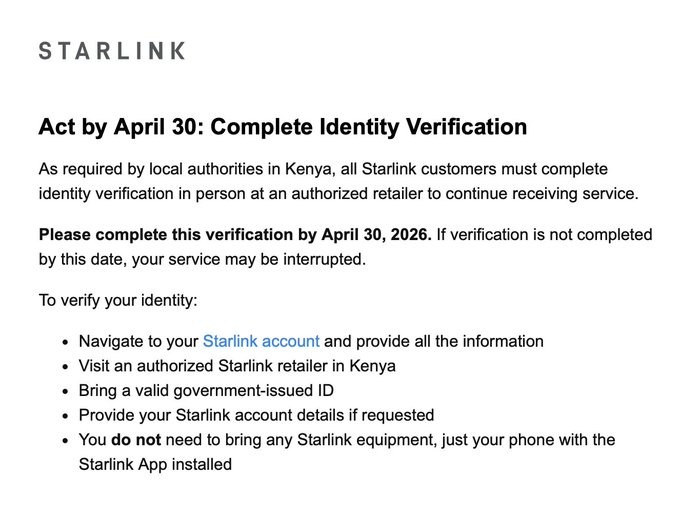
Starlink customers in Kenya are facing a new requirement that mandates in-person identity verification by April 30, 2026, to continue using the satellite internet service. The move, announced in a notice to users, is being implemented in compliance with local regulatory directives. Customers are required to visit an authorized Starlink retailer with a valid government-issued ID and their Starlink account details for verification. Interestingly, Starlink hardware does not need to be brought in, though users must carry a phone with the Starlink app installed.
This verification process aligns Starlink with Kenya’s broader telecommunications regulations, which enforce strict Know Your Customer (KYC) standards on mobile and internet service providers. While Starlink has positioned itself as a decentralized alternative to traditional internet providers, the new requirement brings it closer in line with local authorities’ efforts to regulate digital services.
Starlink and Kenya’s Regulatory Landscape
Kenya’s communications industry has long been governed by the Communications Authority of Kenya (CAK), which enforces KYC regulations on telecom operators to ensure that users are properly registered. These rules apply to mobile networks and internet service providers, including traditional fiber networks. By adopting similar procedures for its satellite-based service, Starlink ensures it complies with these regulations, which are designed to increase security and accountability in the digital space.
In its notice, Starlink explained that the verification process must be completed by the end of April 2026 to prevent service interruptions. Failure to meet this deadline could lead to suspensions, as the service will not be able to continue without proper identity verification. This shift represents a significant change for Starlink, which has previously been seen as an alternative to traditional ISPs, particularly in areas with limited access to terrestrial fiber networks.
A Step Toward Enhanced Control Over Internet Access
Although the verification requirement is framed as a regulatory compliance measure, it also raises important questions about digital rights, privacy, and the degree of state control over internet access. Starlink’s entry into Kenya was initially welcomed by those who viewed it as a resilient alternative to local internet providers, offering a satellite-based infrastructure that bypasses the control of fiber networks. However, tying Starlink accounts to verified physical identities makes it easier for authorities to enforce regulations, including potential suspensions or shutdowns.
This move may not significantly affect service continuity in the short term, but it marks a pivotal shift in how Starlink’s decentralized model operates within the context of Kenyan regulations. The verification process also comes at a time when concerns about state control over digital infrastructure have resurfaced, particularly in light of global trends towards digital surveillance and political control through internet access.
Implications for Users in Kenya
Kenyan Starlink customers now face the task of ensuring that their identities are verified by the deadline to avoid any interruptions to their service. The process requires a visit to an authorized retailer with a government-issued ID and Starlink account information. While this measure aligns with Kenya’s telecommunications regulations, it also means that customers who may have relied on Starlink as an alternative to traditional internet providers must now navigate the same regulatory landscape that applies to local mobile and fiber operators.
For now, Starlink users in Kenya should complete the verification process by the April 30, 2026, deadline to avoid disruptions. Whether this verification system will continue to evolve or remain a one-time requirement remains to be seen, but for the moment, it represents a critical step in formalizing the relationship between Starlink and Kenya’s telecommunications regulatory framework.