

KRA WhatsApp tax filing lets Kenyan traders generate eTIMS invoices and file returns easily using a simple chatbot without visiting iTax
The KRA WhatsApp service is quickly changing how traders in Kenya handle tax compliance. For years, many small businesses struggled with the complexity of eTIMS and the iTax platform. Processes often felt slow, technical, and time-consuming. As tax season approaches, the introduction of a WhatsApp-based solution offers a more accessible alternative. Instead of navigating multiple portals, traders can now manage key tax tasks directly from their phones.
Across Kenya, digital tools continue to reshape how government services are delivered. However, adoption has not always been smooth, especially for informal traders and small business owners. Many lacked the time or technical skills needed to fully engage with systems like eTIMS. As a result, compliance gaps remained a challenge. The KRA WhatsApp chatbot aims to bridge that gap by offering a familiar and user-friendly interface that works on nearly any smartphone.
This shift is significant because it aligns tax services with platforms people already use daily. WhatsApp has become one of the most widely used communication tools in Kenya. By integrating tax services into this environment, the Kenya Revenue Authority is lowering the barrier to compliance. The new system allows traders to generate invoices, access return filing guidance, and manage records without needing advanced technical knowledge.
How KRA WhatsApp Tax Filing Works
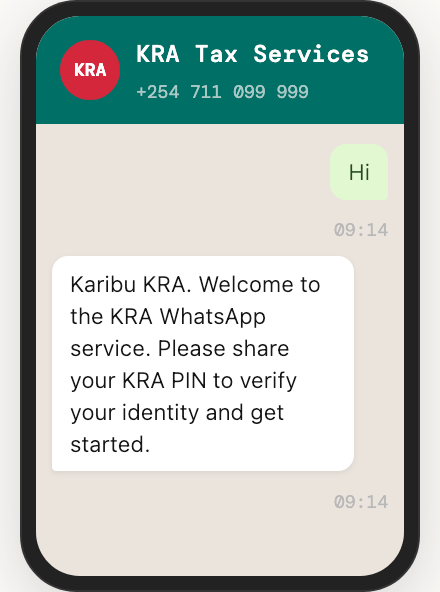
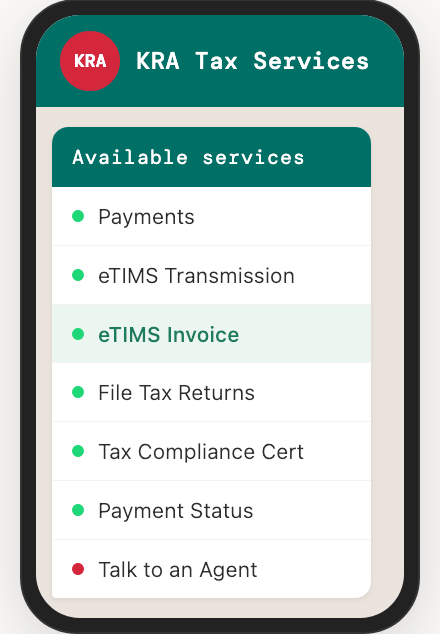
The KRA WhatsApp system operates through a chatbot that guides users step by step. Once a trader saves the official KRA number and sends a greeting, the bot immediately presents a menu of services. These include invoice generation, return filing support, and tax compliance services.
Importantly, the system works around the clock. This means traders can generate invoices at any time, even outside normal business hours. The chatbot responds instantly, making the process faster compared to traditional methods.
Requirements Before Using KRA WhatsApp
Before accessing the KRA WhatsApp service, traders must meet a few basic requirements. First, you need a registered KRA PIN and an active account on iTax. Without this registration, the chatbot cannot link your activity to your tax profile.
In addition, you need a WhatsApp-enabled phone and basic transaction details. These include your buyer’s information, product description, and pricing. Having these details ready ensures a smooth and quick process.
Verifying Identity Through KRA WhatsApp
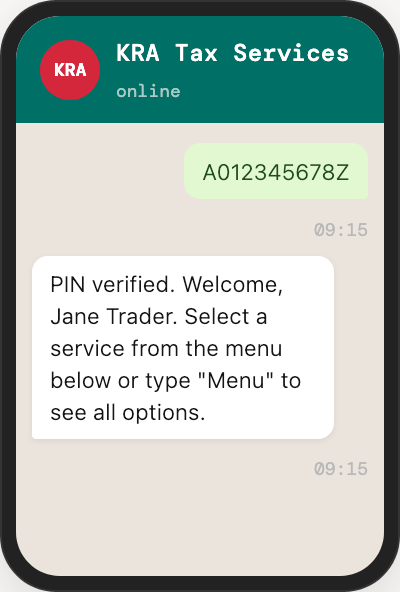
Once the session begins, the chatbot asks for your KRA PIN. This step is essential because it connects your activity directly to your taxpayer account. After verification, the system confirms your registered business name.
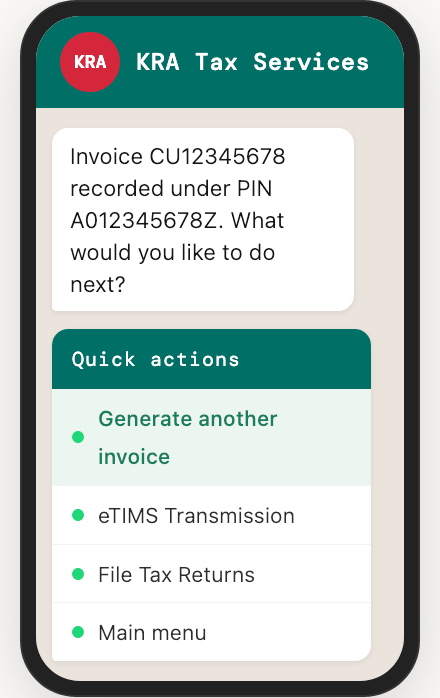
From that point forward, every invoice generated through KRA WhatsApp is automatically recorded under your PIN. This real-time linkage ensures that all transactions are properly captured for tax reporting purposes.
Generating eTIMS Invoices Using KRA WhatsApp
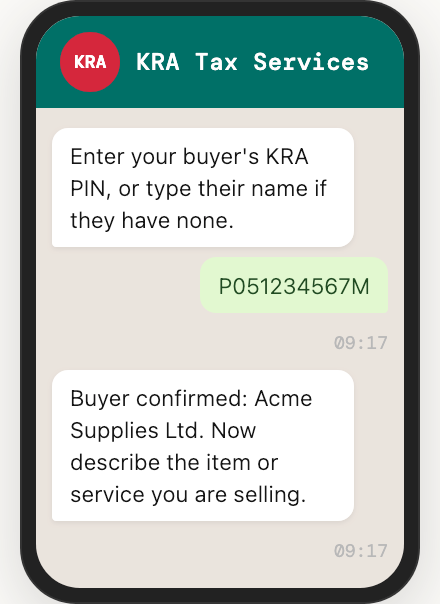
The most popular feature of the KRA WhatsApp system is eTIMS invoice generation. After selecting the service, the chatbot prompts you to enter buyer details. If the buyer has a KRA PIN, the system validates it instantly.
For customers without a PIN, you can manually input their name. While the invoice will still be generated, having a valid buyer PIN is important for accurate tax reporting and expense validation.
Next, you enter the product or service details, including quantity and price. The chatbot calculates totals automatically and applies the correct tax rate. If you are VAT-registered, the system includes the standard VAT charge. Otherwise, it processes the transaction as non-VAT.
Confirming and Receiving Your Invoice
After entering all details, the chatbot displays a summary for confirmation. This step is critical because once submitted, the invoice cannot be edited. Any corrections would require issuing a credit note.
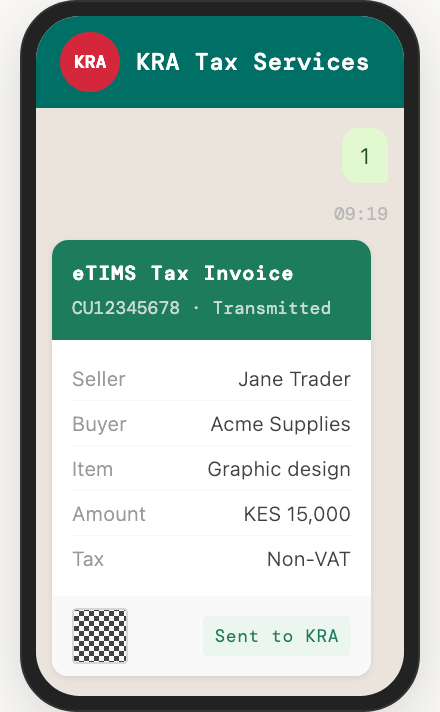
Once confirmed, the KRA WhatsApp system instantly transmits the invoice to the eTIMS platform. Within seconds, you receive an SMS with a download link to the PDF invoice.
The generated invoice includes a unique control number and a QR code. This ensures full compliance and makes it easy to share the document with your customer through WhatsApp, email, or print.
How KRA WhatsApp Supports Tax Return Filing
Beyond invoicing, the KRA WhatsApp service also helps with return filing. Every invoice created is stored in the eTIMS database under your PIN. When it is time to file returns, your data is already available.
This reduces the need to manually compile records. Instead, traders can review pre-filled data and complete their returns more efficiently. The chatbot also provides guidance on filing steps, making the process easier for users who are less familiar with tax procedures.
Why KRA WhatsApp Matters for Compliance
The introduction of KRA WhatsApp comes at a critical time. Tax authorities are now stricter about validating expenses against eTIMS records. Any transaction that lacks a valid invoice may be rejected during return filing.
This makes consistent invoicing essential for every trader. By simplifying the process, the WhatsApp solution encourages compliance while reducing the burden on users. It also helps build a digital record of transactions that supports accurate reporting.
Alternative Option for Non-Smartphone Users
For traders without smartphones, KRA has also provided a USSD option through *222#. This service offers similar functionality using a basic phone interface.
While it lacks the visual simplicity of WhatsApp, it still allows users to generate invoices and receive confirmations via SMS. This ensures that all traders, regardless of device type, can comply with tax requirements.
The Bigger Picture for Digital Tax Services
The rollout of KRA WhatsApp reflects a broader trend toward digital transformation in public services. Governments are increasingly adopting tools that meet users where they are, rather than requiring users to adapt to complex systems.
For Kenyan traders, this means fewer barriers and more convenience. As digital adoption grows, solutions like this are likely to play a central role in improving tax compliance and efficiency across the economy.