
Understanding Monthly Rental Income Tax in Kenya: What Landlords Should Know
To improve tax compliance in the real estate sector, Kenya introduced a simplified tax system for residential rental income known as Monthly Rental Income (MRI). This system was rolled out under the Finance Act of 2015 and officially took effect on January 1, 2016.
Designed to ease tax administration for both individuals and corporate landlords, the MRI regime targets residents earning between KES 280,000 and KES 15 million annually from residential property rentals within Kenya. Under the Finance Act 2020, this income bracket was solidified, while further reforms came into force on January 1, 2024, setting a flat tax rate of 7.5% on gross rental income.
This tax is considered final, meaning no deductions are allowed for maintenance expenses, mortgage interest, capital allowances, or losses. Below is a step-by-step guide on how landlords can register their properties, file accurate returns, and make timely payments to avoid penalties and remain tax-compliant.
1. How to Register Your Rental Property on iTax
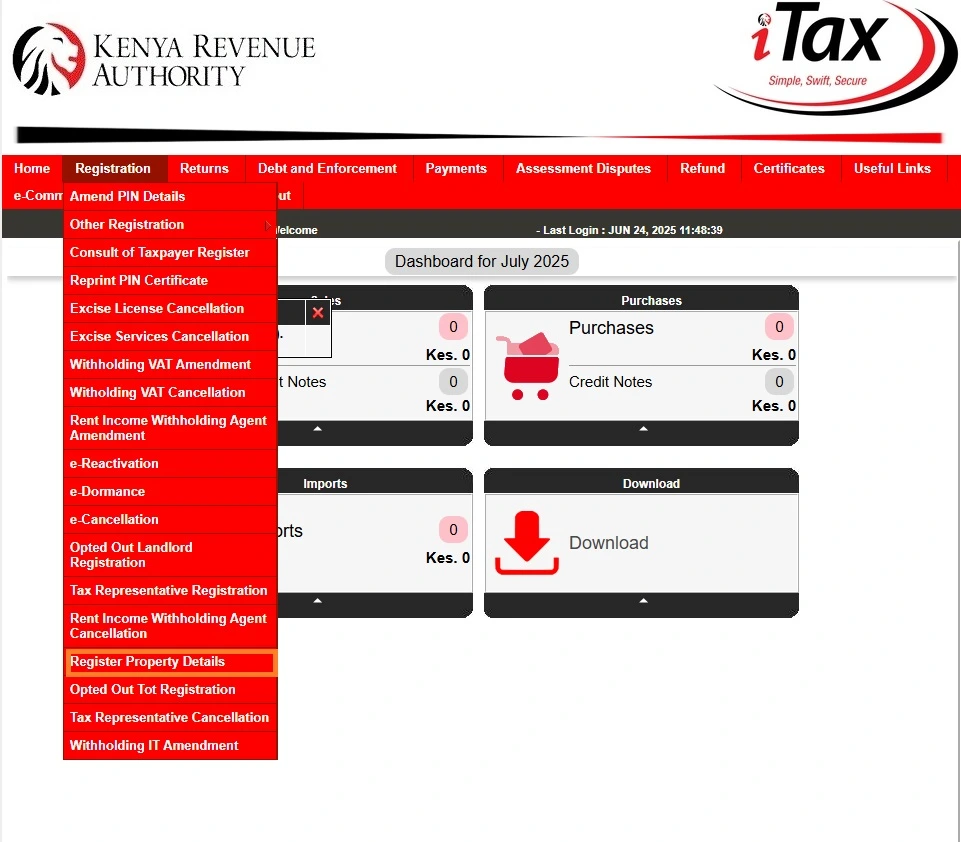
If you own residential rental property in Kenya, you’re required to declare it on the KRA iTax portal. Here’s how to do it:
Steps to Register:
- Visit https://itax.kra.go.ke.
- Click on the “Registration” tab, then choose “Register Property Details.”
- The system presents two sections:
- Section A: Pre-filled with your personal or business tax details.
- Section B: Requires information about your property. You’ll need to select one of the following:
- New Property: For first-time declarations.
- Update Property: If you’re amending existing records.
- Deregister Property: To remove previously listed properties.
- Enter the PIN of one of your tenants, which will auto-populate their name.
- Fill in the required fields, including the monthly estimated rent.
- Add any additional information in the “Application Remarks” section.
- Click Submit. A confirmation Acknowledgement Receipt will be issued.
2. How to File Rental Income Tax on iTax
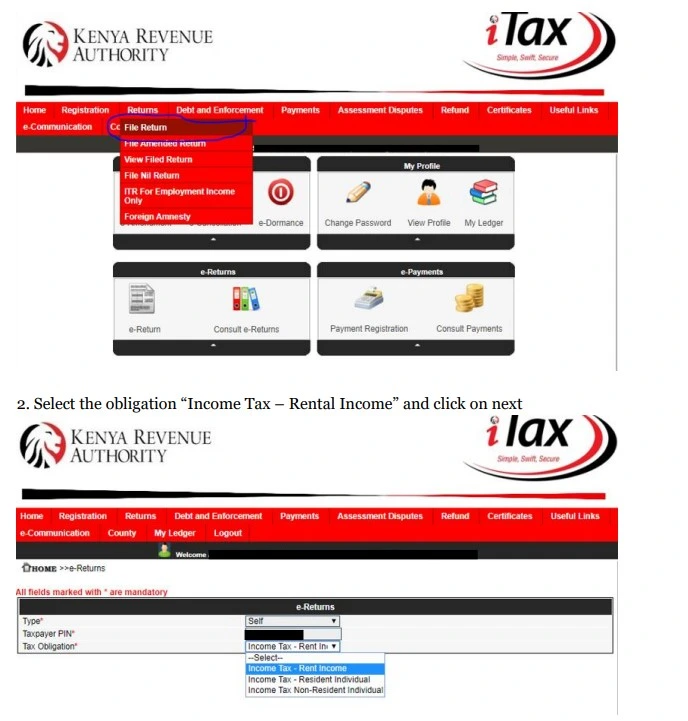
Once your property is registered, landlords must file monthly returns on gross rental income received.
Steps to File a Rental Income Return:
- Visit the iTax portal and navigate to the “Returns” section.
- Click on “File Return”, and choose “Income Tax – Rental Income”.
- Section A: Indicate whether it’s an Original or Amended Return.
- Section B:
- The system will show the number of registered properties (you can manually add if missing).
- Enter the total gross rental income for the month.
- Tax due (7.5%) is calculated automatically.
- If there are withholding tax certificates, the details will be pre-filled.
- Review the form and click Submit to complete the filing.
3. How to Pay Rental Income Tax to KRA
After submitting your return, the next step is to pay the assessed tax using a payment registration number generated on iTax.
Steps to Make a Payment:
- On iTax, go to the “Payments” section and select “New Payment Registration.”
- Choose:
- Tax Head: Income Tax
- Tax Sub-Head: Income Tax – Rent
- Payment Type: Self-Assessment Tax
- Specify the relevant month and year.
- Click “Add”, then select your preferred payment method (bank or mobile).
- Click “Submit” to receive a unique payment registration number.
- Use this number to make your payment via mobile money (e.g., M-Pesa) or through your bank.
Note: From 2024, all KRA payments should be made using the single government PayBill number as directed.
Important Notes for Landlords:
- MRI is final tax: Once paid, you are not required to declare rental income in your annual income tax return.
- If you withhold MRI tax on behalf of a landlord, you must remit the amount within 5 working days, along with a written return.
Penalties for Late Filing or Payment of MRI
Compliance is crucial. Delays can result in penalties and interest:
- For individual landlords:
- Late filing: KES 2,000 or 5% of the tax due (whichever is higher).
- For corporate landlords:
- Late filing: KES 20,000 or 5% of the tax due (whichever is higher).
- Late payment penalty: 5% of the unpaid tax.
- Monthly interest: 1% on outstanding tax.
Who is Exempt from MRI?
MRI does not apply to:
- Non-residents.
- Rental income from commercial properties.
- Landlords whose annual rental income exceeds KES 15 million.
Those earning above KES 15 million annually must declare rental income as part of their comprehensive annual income tax returns, alongside other sources of income.
Final Thoughts: Simplifying Compliance for Property Owners
Kenya’s MRI tax regime aims to ease the compliance burden for residential landlords by offering a simple, transparent, and digital-first solution for tax filing. As we move deeper into 2025, embracing this system not only ensures regulatory compliance but also contributes to national development through tax revenue.
For landlords, staying informed, registering properties accurately, and making timely submissions is key to avoiding unnecessary penalties. As Kenya’s digital tax infrastructure continues to evolve, being proactive and using tools like iTax can make all the difference.